INTERIOR BASEMENT WATERPROOFING & SUBFLOOR MEMBRANE
Moisture protection for interior foundation walls & under flooring
Landing Page - Interior Walls and Subfloors
A basement isn’t just extra square footage, it’s valuable living space, a rental income suite, or the ultimate family room. But before you hang drywall or lay flooring, your foundation needs bulletproof protection. Moisture doesn't just seep through cracks; ambient humidity creates hidden condensation behind finished walls.
Our system forms an impenetrable barrier that keeps exterior water out and stops condensation from ever reaching your insulation! Eliminating the risk of wet framing, mold, and costly tear-outs before they start. Protect your investment from the outside in. Basements provide all types of options for your home, including storage space, a games room, or a new living space for yourself or to rent out. In many homes across North America, foundation walls are aging, cracking, or were never properly sealed from the outside. Excavating to fix exterior issues can cost thousands.
Double breath / interior drainage / sump pump / home renovation of old homes
If you're repairing a leaky foundation or renovating the living space, protecting your home from water, mold, and mildew is a big priority.
or if you're renovating an old home
Old houses with basement for renovation of flooring insulation / 70%
Retrofits, renovations, and moisture infiltration
Interior Basement Waterproofing
Sump Pump
This page explains basement waterproofing solutions for existing homes and renovation projects. It covers how interior systems can be installed after construction to manage water intrusion, reduce humidity, and protect finished living spaces. It also outlines when retrofitting an interior waterproofing system is the best option for long-term foundation protection.
Carpet & Laminate Flooring
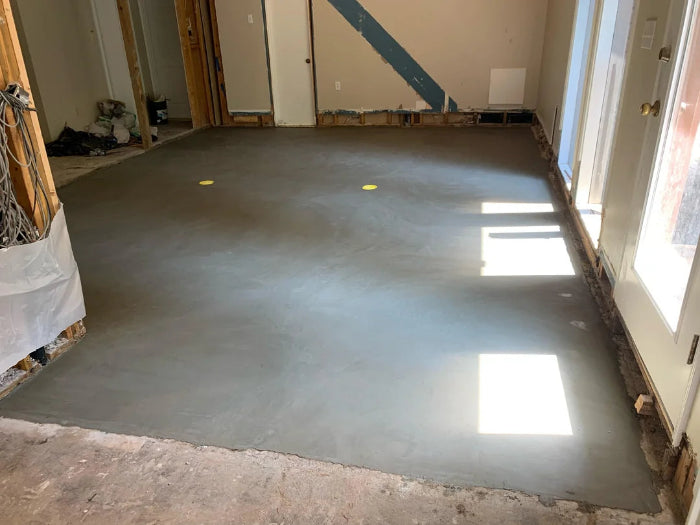
Concrete Subfloors
Pair text with an image to focus on your chosen product, collection, or blog post. Add details on availability, style, or even provide a review.
Collapsible content
What does "below grade" mean?
Below-grade doesn't mean low quality. A below grade structure is any part of a building that sits below the ground level, or finished grade height. Anything below grade is surrounded by soil or backfill. These areas are constantly exposed to groundwater, moisture, and hydrostatic pressure.
Because soil naturally holds water and moisture, it can seep through concrete, travel through cracks or joints, or build up against foundation walls.
What is "Slab on Grade"?
For a standard slab-on-grade foundation, the floor slab is poured at or near ground level directly onto the ground.
A typical Slab on Grade construction has:
- The Soil graded and compacted to provide a stable base.
- Uses crushed rock or gravel to provide drainage.
- A vapor barrier installed under the slab to help prevent ground moisture from entering the slab.
- The concrete slab reinforced to support the building and its loads.
- Thicker edges and footings to provide additional support around the edge and beneath load-bearing walls.
Basement waterproofing:
- Prevents water infiltration through cracks, joints, and porous concrete.
- Controls drainage and hydrostatic pressure around the foundation.
- Channels water toward drain tiles or gravel bases to safely redirect it away from the structure.
- Reduces pressure that can cause leaks, cracks, or foundation movement.
- Prevents moisture-related issues such as mold, mildew, efflorescence, or deterioration of materials.
Why do I need Waterproofing for a basement?
- The Earth holds over 2 million cubic miles of groundwater constantly moving through soil and rock.
- Moisture can migrate upward through soil and concrete by capillary action, sometimes several gallons per day under a 1,000 sq ft foundation.
- Changes in clay soil moisture account for most foundation cracking problems, often up to 90% in affected areas.
- Just 4% moisture in insulation can reduce its thermal efficiency by up to 70%, even though it can’t be seen or felt.
- An average 1,000 sq ft home can place more than 40 tons of weight on its foundation.
Typical basement waterproofing products.
Dampproofing: Dampproof coatings provide only basic protection against dampness. It's an asphalt coating that is applied at 10-20 mils thick.
Waterproofing: Waterproof coatings are a rubberized asphalt emulsion. It creates a tough and permanent waterproof barrier. The elastomeric properties allow it to protect small foundation cracks and is applied at 40–60 mils thick.
Dimpled Membranes: are a tough dimpled high-density polyethylene (HDPE) plastic sheet. They create an air gap between the foundation and the soil and can bridge typical foundation cracks with ease. They remove the hydrostatic water pressure off the face of the wall. Any water or moisture that gets behind the membrane is stopped by gravity and goes out to the perimeter drainage system. When installed over a waterproof coating they protect the waterproof coating and enhance the protection of the foundation.
Drainage Mats: Are dimpled membranes with a Geo-Textile fabric heat fused to the dimple side. They are installed with a waterproof coating so that the geo-textile layer is against the soil. This filters out soil and debris to protect the waterproofing coating and provide a permanent drainage layers.
What is the best basement waterproofing?
There is no single “best” waterproofing solution, it varies based on the application and project requirements. The right system depends on soil conditions, drainage design, climate, and construction type. The design specifications will usually be specified by the site engineer.
- New home or single family dwelling typically use waterproof coatings, dimpled membrane or both.
- Townhouse complexes and commercial applications use waterproof coatings and drainage mats.
- Interior applications are used where the basement area is for unfinished basement or if exterior excavation is not possible. It will be installed up to grade height and feed into a sump pump.

What is the best basement waterproofing?
There is no single “best” waterproofing solution, it varies based on the application and project requirements. The right system depends on soil conditions, drainage design, climate, and construction type. The design specifications will usually be specified by the site engineer.
- New home or single family dwelling typically use waterproof coatings, dimpled membrane or both.
- Townhouse complexes and commercial applications use waterproof coatings and drainage mats.
- Interior applications are used where the basement area is for unfinished basement or if exterior excavation is not possible. It will be installed up to grade height and feed into a sump pump.
For new home and commercial applications, the design specification will usually be specified by the site engineer.